Accent Plantings
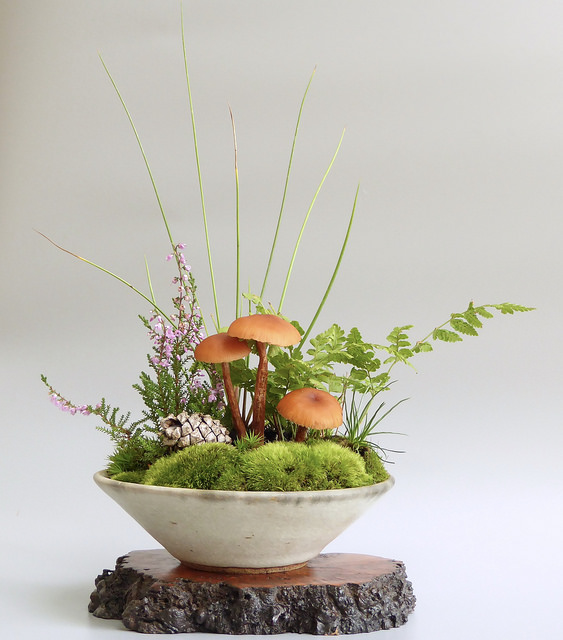
Accent Plantings
"Accent plantings" are the small potted plants that are often used to accompany bonsai, in shows or private display areas at home. As well as items that complement bonsai, they can be displayed as stand-alone plantings.
There are two main types of planting. The most commonly seen are 'Shitakusa', which are small, low-lying plantings normally used for display alongside bonsai. They may include one or more types of plant. Larger compositions, which normally include multiple plants, are called 'Kusamono'. These may also be displayed in their own right, rather than simply as accompaniments, and can be quite large.
For Kusamono in particular, when selecting plants one should pay attention to assembling a good mix of plants in terms of species and arrangement in the pot. It is useful to think of what is going at the top, middle and bottom levels of the planting, with different points of interest at each. The same is true of the foreground and background of the composition. Shitakusa are often simpler, but can be planned according to the same principles.
A great variety of plants can be used for Shitakusa and Kusamono. The best choices are plants that will grow readily in the conditions in your garden, without too much fuss. Mosses, scraped up from your driveway for example, are present in many plantings and are useful as a foreground / lowest level plant. Other low-lying, creeping plants such as some dwarf thymes serve a similar function. Miniature hostas are always popular, for their attractive foliage and flowers. Ferns are very useful and widely used. Smaller varieties are better, but if you find seedling ferns (e.g. growing from a crack in your garden wall) these can be maintained at a very small size, being dwarfed by pot culture in the same way as bonsai. Ornamental grasses, particularly shorter varieties, are suitable subjects. Flowering plants such as rhodohypoxis, dwarf cyclamen, and a multitude of others can add a splash of colour.
Suitable plants can be obtained in many ways. There are likely to be suitable plants already growing in your garden, which can provide a source of ready material. In garden centres, the alpine and water-gardening areas (look at the marginal plants) offer suitable materials. Plants can also be grown from seed, or sourced from specialist suppliers (many of whom sell online nowadays). If you collect trees (with appropriate permission of course) then you will often find suitable plants growing in the native soil that comes home with you in the rootball of the tree. When combining different species in the same pot, ensure that they are varieties that need roughly the same growing conditions, water and light levels and so on.
A great variety of containers can be used as pots for accent plantings. Pots tend to be less formal than those used with most bonsai. While rustic designs and colours are popular and appropriate, some accent pots are very striking and inventive in terms of shape and glaze. Suitably shaped stones or pieces of wood can also be used.
Because accent plantings are generally shorter-lived than bonsai, which we may maintain in the same pots for many years, soil choice is less critical. If one were to use a 'bonsai mix' then a fine-grained shohin-style mix would be most appropriate. However, soils such as traditional potting compost can be used successfully as long as attention is paid to watering requirements. Plants can often be successfully maintained using the soil they were growing in when you got them.
Watering plants in small pots can be challenging, especially during the summer. One useful approach is to place your accent pots in a large garden tray (with drain holes) full of a suitable substrate such as bonsai mix, moler clay granules, or grit. When you water your pots, the run-off will be absorbed by the substrate in the tray. This helps the pots stay cool and moist. Roots will grow through the pot drainage holes into the tray, and can simply be trimmed off when you remove the accent pot. Accent plantings will need fertilising – any general-purpose garden fertiliser should work, following the instructions on the label for potted plants (though perhaps at a slightly weaker concentration than one might normally use). Accent plantings change rapidly as the component plants grow fast and change with the seasons. They are unlikely to look at their peak condition all through the year, and will require regular trimming and maintenance.
In a display, the accent planting would not usually be placed directly on the table. As with bonsai, stands are used. However, in the case of accent plantings these are normally very simple and low-level. Attractive wood slices are popular. Wood slats and bamboo mats are often also seen, and ceramic 'tiles' can also be used.
When choosing plants and composing displays, there are a number of factors to be born in mind. One is the size of the plantings, in relation to the trees – accents should not overpower the display. They should complement the tree rather than competing with it for viewers' attention. There is a general rule that the height of the accent planting should not exceed the top of the stand on which the bonsai is placed. With bonsai on low stands, this can be an important consideration. The exception to this might be where a single flower or head of grass stands up above the height of the table, as long as it is complementary to the tree.
Another general guideline is that repetition should be avoided within the display. One would normally not place an accent planting in the same style of pot, or on the same type of stand, as the main tree. If a ceramic pot has been used, one would place it on a wooden base, not a ceramic tile (while a planting on a piece of driftwood could go on a ceramic). The movement of the tree and the planting should both be considered when deciding on placement in the display: they should 'face' each other.
It is best to use plants that are complementary to the trees being shown. For example, a Scots pine might work well paired with a low accent planting including heather and wild thyme, which evokes mountain landscapes. It might work less well with a tropical orchid, or desert succulent. This involves considering the landscapes in which both the trees and the accent plants would normally be found: for example, native woodland trees would ideally be paired with plants that would look at home in the same environment. The time of year is also important – accents should ideally evoke the season of display. Using snowdrops in late summer for example, if that were even possible, would look odd. Some ubiquitous plantings however, such as ferns and mosses, work well in most scenarios.
For more information, the book "Bonsai Kusamono Suiseki: A practical guide for organizing displays with plants and stones" by Willi Benz is an excellent and detailed source. "Methods of Bonsai Display" by Paul Goff also has good material, while "Four Seasons of Bonsai" by Kyuzo Murata has some inspirational images of kusamono (as well as bonsai).

